
Cooker hood installation · Scotland
Cooker hood installation in Edinburgh
Our cooker hood installation work covers the whole of Edinburgh, and we also work in neighbouring the Lothians and Fife.
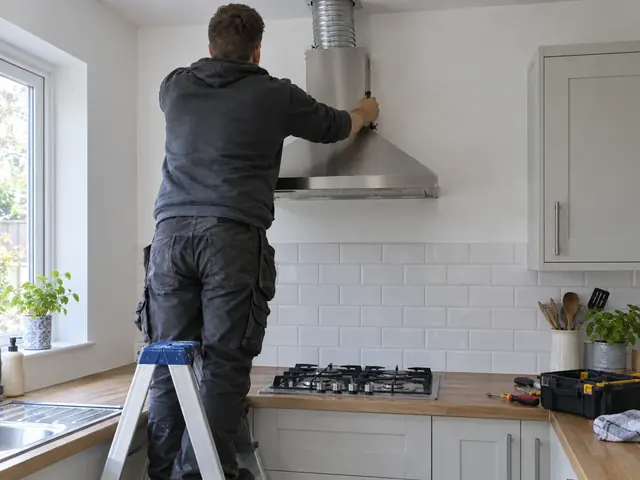
Why do people in Edinburgh choose cooker hood installation?
Cooks across Edinburgh who fry, grill or stir-fry often find a recirculating hood leaves smells in the house, and look at ducting the air outside instead.
If your Edinburgh house has thick solid walls, core drilling a neat hole for the duct takes the right equipment and careful positioning of the outside grille.
What does cooker hood installation in Edinburgh include?
Your written quote lists everything included. For cooker hood installation, that normally means:
- Survey of the hob position, duct route, outside wall and any open-flued appliance
- Hood fixed at the height set by the hood and hob manufacturers
- Core drilling through the outside wall and an external grille fitted and sealed
- Short, straight runs of rigid ducting wherever the route allows
- Island and ceiling hoods fixed into the ceiling structure by two people
- Recirculating hoods fitted with carbon filters, and their limits explained
- Power supply connected by an electrician and tested to BS 7671
- Spillage test by a Gas Safe registered engineer where an open-flued appliance is present
How much does cooker hood installation cost in Edinburgh?
Use these ranges to plan your budget. They include VAT, reflect costs in Edinburgh and Glasgow, and are firmed up once we have seen your Edinburgh kitchen. Prices across Edinburgh and Glasgow are broadly in line with UK averages.
| Typical project | Guide price |
|---|---|
| Like-for-like cooker hood swapSame position and ducting | £120–£240 |
| New ducted hood through an outside wallCore drilling, ducting run and external grille | £310–£920 |
| Island or ceiling hood installedTwo-person install, fixings to the ceiling structure | £310–£640 |
| Recirculating hood fittedNo ducting; carbon filters need replacing | £120–£310 |
Guide ranges cover fitting and connection with standard ducting through a straightforward wall; long or concealed duct runs, ceiling repairs, new electrical spurs, spillage tests and the hood itself are priced separately. Prices include VAT at 20%.
Kitchens in homes across Edinburgh
The housing mix across Edinburgh includes Victorian tenement flats, Georgian New Town flats, stone villas and post-war council-built houses, so no two kitchen fits are quite alike. Tenement flats often have a small kitchen off the hall, while Georgian flats may have kitchens in former bedrooms or reception rooms with tall ceilings.
Edinburgh's mains water is soft, so limescale is rarely a problem and taps, sinks and boiling water taps stay cleaner for longer. Common stairs without lifts, controlled parking and cobbled streets in older parts of the city mean deliveries and stair carries need planning before fitting day.
Tenement and Georgian flats often have kitchens in small rooms, and opening one into the living room needs a building warrant if the wall is load-bearing, and can need one even if it is not, where the change affects the escape route or fire separation in a flat. Stone villas and bungalows on the edge of the city more often suit a larger supply-and-fit kitchen.
Rules for cooker hood installation in Edinburgh
In Scotland, standard 3.14 of the domestic Technical Handbook expects kitchens to have extract ventilation, and a recirculating hood alone does not remove moisture. Fitting an extractor fan or a ducted hood does not normally need a building warrant. In a flat, a new vent through a shared outside wall may need the other owners' agreement and planning permission, and a listed building may need listed building consent. Where the room has an open-flued gas appliance, a Gas Safe registered engineer should carry out a spillage test after the hood is fitted.
The Old and New Towns form a World Heritage Site with many listed buildings, so new vents or internal changes may need consent, and tenement neighbours may need to agree.
Before you start
- Keep the duct run short and straight with rigid ducting, because every bend and extra metre of flexible hose reduces how much air the hood moves.
- Check the minimum height above the hob in both the hood and hob instructions, and use the greater of the two figures.
- For an island or ceiling hood, find out what is above the ceiling, as joists or added timbers are needed to carry the weight securely.
- In a flat or a listed building, check what consents are needed before any hole is cut through an outside wall.
- For an island hood in your Edinburgh kitchen, settle the hood position before the ceiling is boarded, so timber supports can be added in the right place.
- Check whether your Edinburgh home has an open-flued boiler or gas fire, and mention it at the survey so a spillage test can be planned.
Questions about cooker hood installation in Edinburgh
How much does cooker hood installation cost in Edinburgh?
Guide prices in Edinburgh are about £120 to £240 including VAT for a like-for-like cooker hood swap. The final price depends on the size of the kitchen and what is moving, and is set out in an itemised written quote.
Do you cover the whole of Edinburgh?
Yes. We carry out cooker hood installation across Edinburgh. Every job starts with a free survey visit and an itemised written quote.
How high should a cooker hood be above the hob?
At least the minimum distance given by the manufacturers. Both the hood and the hob instructions set a minimum gap between them, and where they differ the greater figure should be used. Gas hobs usually need more clearance than induction. A hood fitted too low is a fire risk, while one fitted much higher than recommended captures less steam.
Should I choose a ducted or a recirculating cooker hood?
A ducted hood is usually more effective, because it takes steam, smoke and smells outside. A recirculating hood passes air through grease and carbon filters and returns it to the room, so it deals with grease and smells but not moisture, and another means of extract is usually needed. Recirculating suits kitchens with no practical duct route, and its carbon filters need replacing.
Why might a cooker hood need a spillage test?
Because a hood pulling air out of a room can draw fumes back down the flue of an open-flued gas appliance, such as some older boilers or gas fires. Where the kitchen, or a room open to it, has one, a Gas Safe registered engineer should carry out a spillage test with the hood running at full speed. Room-sealed boilers are not affected in the same way.