
Kitchen underfloor heating · England
Kitchen underfloor heating in Gloucestershire
If you need kitchen underfloor heating anywhere in Gloucestershire, we survey the kitchen, agree the scope with you and book every trade through to handover.
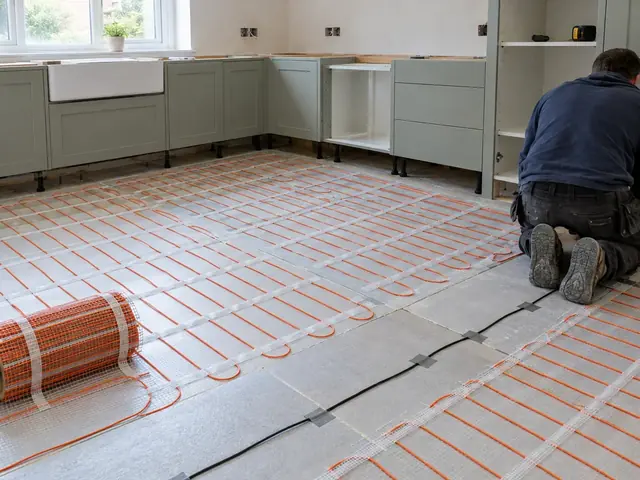
Why kitchen underfloor heating for a Gloucestershire home?
People planning a heat pump in Gloucestershire sometimes add underfloor heating to the kitchen at the same time, while the old floor is already up and the room is empty.
Many Gloucestershire kitchens lose their only radiator wall to a new run of units, and underfloor heating keeps the room warm without giving up storage.
What does kitchen underfloor heating in Gloucestershire include?
Every kitchen is different, so we confirm the scope in writing. Most jobs of this kind include:
- A survey of the subfloor, open floor area and existing heating system
- A heating layout drawn to the kitchen plan, clear of units and appliances
- Insulation boards so the floor responds more quickly when the heating comes on
- Electric mats or cables, or wet pipework connected through a manifold
- A new circuit or fused spur, plus a thermostat with a floor sensor
- Screed, overlay boards or levelling compound, left to cure before finishes
- Door thresholds and plinth heights checked against the new floor build-up
- Plinth heaters fitted under base units where wall space for a radiator is short
How much does kitchen underfloor heating cost in Gloucestershire?
Typical kitchen underfloor heating prices for homes in Gloucestershire, including VAT and adjusted for the South West. Your own figure depends on the size of the kitchen, the layout and what is moving. Costs in the South West sit close to the national guide.
| Typical project | Guide price |
|---|---|
| Electric underfloor heating, kitchen floorMat or cable system, insulation board and thermostat | £620–£1,500 |
| Wet underfloor heating, kitchen floorPipes, manifold, screed or overlay boards | £1,500–£4,100 |
| Plinth heater fitted under a base unitElectric or hydronic, where wall space is short | £260–£620 |
Guide prices cover the heating system, insulation boards, controls and connection with testing; the floor finish, subfloor repairs, a consumer unit upgrade and any boiler or heat pump changes are priced separately. Prices include VAT at 20%.
Kitchens in homes across Gloucestershire
You will find cotswold stone cottages, Regency townhouses, Victorian terraces and post-war estate houses throughout Gloucestershire. Cotswold stone cottages often have a small kitchen in a rear extension, while Regency townhouses in Cheltenham may have a long kitchen at garden level or in a former basement.
Hard water is the norm across most of Gloucestershire, so expect limescale on taps and appliances and think about a filter for a boiling water tap. Stone villages with narrow lanes and limited parking can make deliveries slow, and townhouse flats over several floors may mean carrying units up stairs.
If your home is a Cotswold stone cottage, the walls are often thick and uneven, so tall units and worktops need careful scribing. Regency and Victorian townhouses sometimes have kitchens on lower floors, where damp, low ceilings and the route for waste pipes can shape the layout.
Rules for kitchen underfloor heating in Gloucestershire
In England, electric underfloor heating needs a supply and a thermostat. A new dedicated circuit is notifiable under Part P and is certified through a competent person scheme or building control, while a fused spur from an existing circuit is not notifiable in England but must still meet BS 7671 and be certified. A wet system is joined to your existing heating, and any work on a gas boiler is for a Gas Safe registered engineer.
Listed stone cottages, Cheltenham's Regency terraces and homes in conservation areas may need consent before new vents are cut or historic features are removed.
Before you start
- Check the new floor build-up height early; it affects door thresholds, plinth heights and whether integrated appliances still fit under the worktop.
- Allow time for screed or levelling compound to cure before tiles or other finishes go down, as laying too soon risks cracks and lifting.
- Insulation boards under an electric system help the floor warm up more quickly, especially when it is laid over a cold concrete slab.
- Make sure your chosen finish suits underfloor heating; vinyl tiles and engineered wood have maximum surface temperatures set by their manufacturers.
- If your Gloucestershire home has a suspended timber floor, ask how the heating will be supported and insulated between the joists.
- Ask for the finished floor height to be worked out before you order units for your Gloucestershire kitchen, so plinths and appliances still fit.
Questions about kitchen underfloor heating in Gloucestershire
How much does kitchen underfloor heating cost in Gloucestershire?
For electric underfloor heating for a kitchen floor, budget around £620 to £1,500 including VAT in Gloucestershire. That reflects typical costs in the South West; we confirm the actual figure in writing once we have measured up.
Do you cover the whole of Gloucestershire?
Yes. We carry out kitchen underfloor heating across Gloucestershire, including Gloucester, Cheltenham, Stroud and Kingswood. Every job starts with a free survey visit and an itemised written quote.
Is electric or wet underfloor heating better for a kitchen?
It depends on the floor and the heating you already have. Electric mats are thin, quick to lay and suit a single kitchen floor during a refit. Wet systems use warm water from the boiler or heat pump, need more floor depth and a manifold, and make more sense when a larger area, such as a whole kitchen-diner floor, is being relaid at the same time.
Can underfloor heating go under kitchen units?
No, it is not usually laid under fitted units, plinths or appliances. Heat trapped beneath a cabinet or appliance can build up and damage the system or the floor, and it warms nothing useful. The heating layout follows the kitchen plan, covering the open floor, walkways and any dining area, which is why the units are set out before the heating goes down.
How soon can a floor be tiled over underfloor heating?
It depends on what the heating is laid in. Thin levelling compounds over electric mats are generally ready far sooner than a traditional sand and cement screed over wet pipes, which needs much longer to dry. The product instructions set the curing time, and the heating should be brought up to temperature gradually, following the system's commissioning guidance, rather than used to dry the floor.
Kitchen underfloor heating in towns across Gloucestershire
Choose a town for local guide prices and postcode coverage:
- Kitchen underfloor heating in Gloucester
- Kitchen underfloor heating in Cheltenham
- Kitchen underfloor heating in Stroud
- Kitchen underfloor heating in Kingswood
- Kitchen underfloor heating in Yate
- Kitchen underfloor heating in Tewkesbury
- Kitchen underfloor heating in Cirencester
- Kitchen underfloor heating in Lydney