
Kitchen flooring · Greater London
Kitchen flooring in Hornchurch
From the survey to handover, kitchen flooring in Hornchurch is run by us as one job, with the fitters and trades booked in the right order.
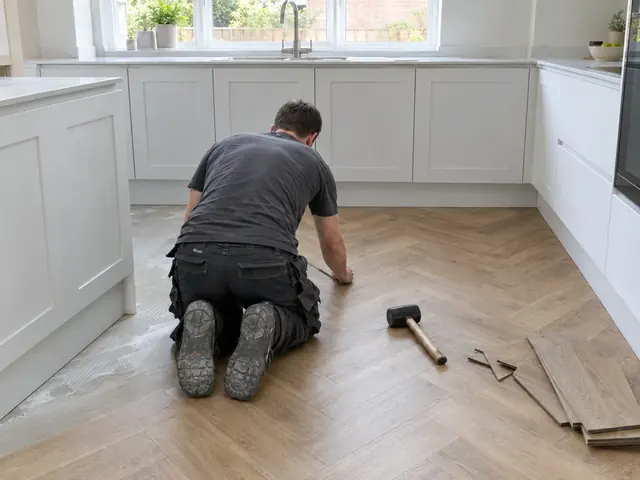
What prompts kitchen flooring in Hornchurch?
Landlords in Greater London often want a floor that survives several tenancies, so sheet vinyl or tiles with a darker grout are common choices for rental kitchens.
If your Hornchurch kitchen has curling vinyl, cracked tiles or boards that have swollen near the sink, a new floor can be laid without changing the units. We work throughout Hornchurch (RM11 and RM12) and across the wider Greater London area.
What is in a typical job?
Your written quote lists everything included. For kitchen flooring, that normally means:
- Free survey visit to check the subfloor, measure up and give an itemised quote
- Levelling compound or a plywood overlay to give a flat, firm base
- Flooring run under appliance spaces so machines can be pulled out for servicing
- Moisture checks on concrete floors and screeds before any floor finish is laid
- Underlay suited to the floor finish, the subfloor and any underfloor heating
- Old coverings lifted and removed, with pre-2000 floor tiles checked for asbestos first
What does kitchen flooring cost in Hornchurch?
As a starting point for Hornchurch, these ranges include VAT at 20% and allow for typical labour costs in London. Prices in London usually run above the national guide, mainly because labour and parking cost more.
| Typical project | Guide price |
|---|---|
| LVT or vinyl, kitchen floorPreparation, underlay where needed and trims | £650–£2,000 |
| Porcelain or ceramic tiles, kitchen floorPreparation, adhesive, grout and trims | £1,200–£2,600 |
| Floor levelling or new plywood baseSo the floor finish and units sit flat | £390–£1,200 |
Guide prices are for a typical-sized kitchen floor, including preparation, adhesive or underlay and trims; the material you choose, open-plan floor areas and any levelling or plywood base are confirmed at the survey. Prices include VAT at 20%.
What kind of kitchens do we fit in Hornchurch?
The housing mix across Greater London includes Victorian and Edwardian terraces, conversion flats, mansion block flats and 1930s semis, so no two kitchen fits are quite alike. Victorian terraces often have a narrow galley beside the side return, while conversion flats and mansion blocks usually fit the kitchen into a small room or along one living-room wall.
London's mains water is hard, so limescale builds quickly on taps and boiling water taps, and a scale-reducing filter is worth planning in. Permit parking, red routes and flats without lifts are common, so parking suspensions, stair carries and lift bookings may need arranging before delivery day.
What rules apply to kitchen flooring in Hornchurch?
A new kitchen floor in England needs no planning permission or building regulations approval. In a flat, check the lease first: leases often require a sound-reducing underlay, or forbid hard floors without the freeholder's consent. If electric underfloor heating goes under the new floor on a new circuit, that circuit is notifiable under Part P. In a listed building, removing historic floors may need listed building consent.
Conservation areas are widespread across London, so a new extractor vent on a front wall may need permission, and leaseholders usually need the freeholder's written consent first.
Getting the most from your kitchen flooring
- Keep pets and children off a newly tiled floor until the grout has set, and put felt pads on chair legs if your Hornchurch kitchen has LVT or wood.
- Ask for the floor to continue under the dishwasher and fridge spaces, so appliances can be slid out for repair without lifting the edge of the floor.
- Keep a few spare boards or tiles from your Hornchurch kitchen floor in the loft or garage, so a damaged piece can be swapped for an exact match later.
- Engineered wood can suffer near sinks and dishwashers, where leaks and standing water are most likely, so it may be less suited than LVT or tiles.
Questions about kitchen flooring in Hornchurch
How much does kitchen flooring cost in Hornchurch?
Kitchen flooring in Hornchurch typically costs £650 to £2,000 including VAT for an LVT or vinyl kitchen floor, based on prices in London. Larger or more involved jobs cost more, and your price is fixed in writing after a free survey visit.
Do you cover all of Hornchurch?
Yes. We work across Hornchurch, including the RM11 and RM12 postcode districts, and nearby towns such as Romford and Dagenham. Book a free survey visit and we will arrange a time that suits you.
Is engineered wood a good choice for a kitchen floor?
It can be, but it needs more care than LVT or tiles. Engineered wood can swell or stain if water sits on it, so it is less suited to the areas around a sink or dishwasher, where leaks are most likely. If you choose it, pick a board the maker approves for kitchens, wipe spills promptly and keep the finish maintained.
How long does it take to lay a kitchen floor?
Most kitchen floors take one to two days to lay once the base is ready. Add curing time if a levelling compound is used, which depends on the product and its thickness, and allow much longer for a new screed, which must be dry enough before most floors go down. Tiled floors also need the adhesive and grout to set before heavy use.
Does my kitchen floor need levelling before new flooring?
Often, yes. Thin floors such as LVT and sheet vinyl show every dip and ridge underneath, and tiles can crack if the base flexes or is uneven. Concrete floors are usually smoothed with a levelling compound, while timber floorboards are normally overlaid with plywood screwed down at close centres. We check the floor at the survey and price any preparation as its own line.
Also covering nearby towns
We also carry out kitchen flooring in these towns near Hornchurch:
- Kitchen flooring in Romford
- Kitchen flooring in Dagenham
- Kitchen flooring in South Ockendon
- Kitchen flooring in Thamesmead
- Kitchen flooring in Brentwood
- Kitchen flooring in Barking
- Kitchen flooring across Greater London