
Cooker hood installation · Scotland
Cooker hood installation in Dunbartonshire
Cooker hood installation in Dunbartonshire starts with a free visit to measure up, then a written scope and quote before any work begins.
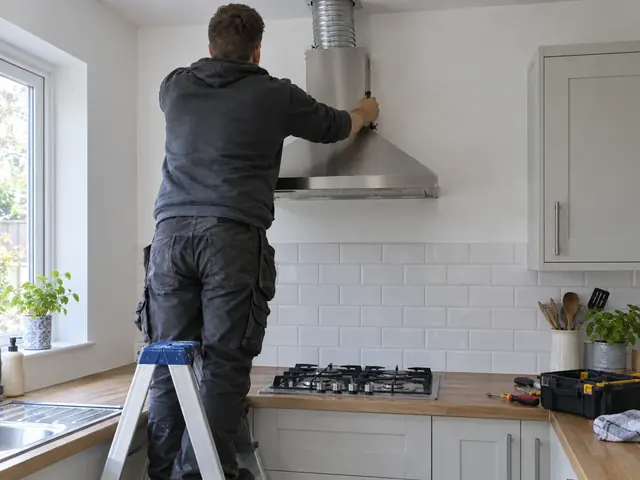
Why do people in Dunbartonshire choose cooker hood installation?
Homeowners in Dunbartonshire adding a hob to a new island often need a ceiling hood with solid fixings and a duct route planned before the ceiling is closed up.
A new kitchen in a Dunbartonshire home can move the hob away from the old vent, so the hood, the duct run and the wall grille all need rethinking together.
What does cooker hood installation in Dunbartonshire include?
After the survey visit we write the scope down. For cooker hood installation in Dunbartonshire it usually covers:
- Survey of the hob position, duct route, outside wall and any open-flued appliance
- Hood fixed at the height set by the hood and hob manufacturers
- Core drilling through the outside wall and an external grille fitted and sealed
- Short, straight runs of rigid ducting wherever the route allows
- Island and ceiling hoods fixed into the ceiling structure by two people
- Recirculating hoods fitted with carbon filters, and their limits explained
- Power supply connected by an electrician and tested to BS 7671
- Spillage test by a Gas Safe registered engineer where an open-flued appliance is present
How much does cooker hood installation cost in Dunbartonshire?
As a starting point for Dunbartonshire, these ranges include VAT at 20% and allow for typical labour costs in Scotland. Prices in Scotland usually come in below the national guide, as labour rates are lower than in the South East.
| Typical project | Guide price |
|---|---|
| Like-for-like cooker hood swapSame position and ducting | £110–£230 |
| New ducted hood through an outside wallCore drilling, ducting run and external grille | £280–£850 |
| Island or ceiling hood installedTwo-person install, fixings to the ceiling structure | £280–£590 |
| Recirculating hood fittedNo ducting; carbon filters need replacing | £110–£280 |
Guide ranges cover fitting and connection with standard ducting through a straightforward wall; long or concealed duct runs, ceiling repairs, new electrical spurs, spillage tests and the hood itself are priced separately. Prices include VAT at 20%.
Kitchens in homes across Dunbartonshire
You will find sandstone tenement flats, Victorian villas, interwar bungalows and four-in-a-block flats throughout Dunbartonshire. Villas and bungalows in Bearsden and Bishopbriggs often have separate kitchens with room to open up, while tenements and four-in-a-block flats in Clydebank tend to have small galleys.
Dunbartonshire's water is soft, so limescale is rarely a problem and taps and boiling water taps tend to stay clean. Tenement closes and common stairs mean carrying units by hand, while villa driveways usually make deliveries simpler.
Opening an interwar bungalow kitchen into the dining room is a common way to make a family space, subject to a building warrant if the wall is load-bearing. Tenement flats often have compact kitchens where careful storage planning and slimline appliances help.
Rules for cooker hood installation in Dunbartonshire
In Scotland, standard 3.14 of the domestic Technical Handbook expects kitchens to have extract ventilation, and a recirculating hood alone does not remove moisture. Fitting an extractor fan or a ducted hood does not normally need a building warrant. In a flat, a new vent through a shared outside wall may need the other owners' agreement and planning permission, and a listed building may need listed building consent. Where the room has an open-flued gas appliance, a Gas Safe registered engineer should carry out a spillage test after the hood is fitted.
The northern edge of the area borders Loch Lomond and The Trossachs National Park, and listed buildings or conservation areas may need consent before a new extractor vent is added.
Before you start
- Keep the duct run short and straight with rigid ducting, because every bend and extra metre of flexible hose reduces how much air the hood moves.
- If the kitchen has an open-flued boiler or gas fire, a Gas Safe registered engineer should carry out a spillage test after the hood is fitted.
- In a flat or a listed building, check what consents are needed before any hole is cut through an outside wall.
- For an island or ceiling hood, find out what is above the ceiling, as joists or added timbers are needed to carry the weight securely.
- If your Dunbartonshire home is listed, or in a building with strict rules on outside changes, check what is allowed before any hole is cut for a duct.
- For an island hood in your Dunbartonshire kitchen, settle the hood position before the ceiling is boarded, so timber supports can be added in the right place.
Questions about cooker hood installation in Dunbartonshire
How much does cooker hood installation cost in Dunbartonshire?
Guide prices in Dunbartonshire are about £110 to £230 including VAT for a like-for-like cooker hood swap. The final price depends on the size of the kitchen and what is moving, and is set out in an itemised written quote.
Do you cover the whole of Dunbartonshire?
Yes. We carry out cooker hood installation across Dunbartonshire, including Bearsden, Clydebank, Vale of Leven and Bishopbriggs. Every job starts with a free survey visit and an itemised written quote.
How high should a cooker hood be above the hob?
At least the minimum distance given by the manufacturers. Both the hood and the hob instructions set a minimum gap between them, and where they differ the greater figure should be used. Gas hobs usually need more clearance than induction. A hood fitted too low is a fire risk, while one fitted much higher than recommended captures less steam.
Should I choose a ducted or a recirculating cooker hood?
A ducted hood is usually more effective, because it takes steam, smoke and smells outside. A recirculating hood passes air through grease and carbon filters and returns it to the room, so it deals with grease and smells but not moisture, and another means of extract is usually needed. Recirculating suits kitchens with no practical duct route, and its carbon filters need replacing.
Does a cooker hood need a hole in the wall?
A ducted hood does. The usual route is a core-drilled hole through the nearest outside wall, with rigid ducting from the hood and an external grille sealed into the wall. Where the hob is far from an outside wall, the duct can sometimes run above the wall units or through a ceiling void. A recirculating hood needs no hole, but it removes no moisture.
Cooker hood installation in towns across Dunbartonshire
Choose a town for local guide prices and postcode coverage:
- Cooker hood installation in Bearsden
- Cooker hood installation in Clydebank
- Cooker hood installation in Vale of Leven
- Cooker hood installation in Bishopbriggs
- Cooker hood installation in Dumbarton
- Cooker hood installation in Kirkintilloch