
Kitchen underfloor heating · Scotland
Kitchen underfloor heating in Dumfries and Galloway
Our kitchen underfloor heating work covers the whole of Dumfries and Galloway, including Dumfries, Stranraer and Annan.
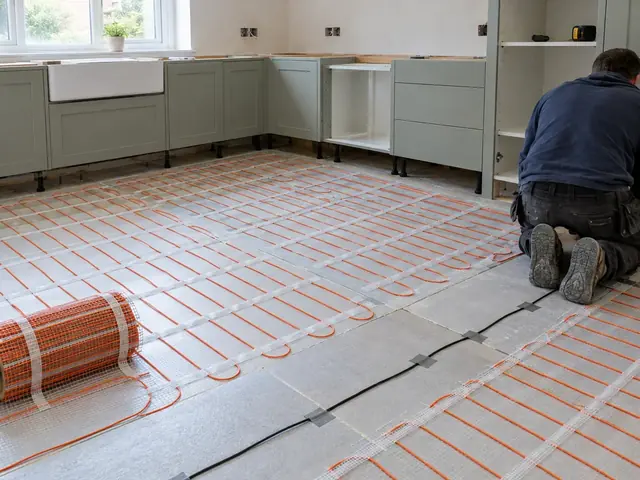
When does kitchen underfloor heating make sense in Dumfries and Galloway?
In a compact Dumfries and Galloway kitchen with no room for a radiator at all, a plinth heater tucked under a base unit can be the simplest answer.
Kitchen-diners across Dumfries and Galloway often have a large stretch of open floor, which can suit a wet system run from the existing boiler or heat pump.
What does kitchen underfloor heating in Dumfries and Galloway include?
After the survey visit we write the scope down. For kitchen underfloor heating in Dumfries and Galloway it usually covers:
- A survey of the subfloor, open floor area and existing heating system
- A heating layout drawn to the kitchen plan, clear of units and appliances
- Insulation boards so the floor responds more quickly when the heating comes on
- Electric mats or cables, or wet pipework connected through a manifold
- A new circuit or fused spur, plus a thermostat with a floor sensor
- Screed, overlay boards or levelling compound, left to cure before finishes
- Door thresholds and plinth heights checked against the new floor build-up
- Plinth heaters fitted under base units where wall space for a radiator is short
How much does kitchen underfloor heating cost in Dumfries and Galloway?
The figures below are guide prices for Dumfries and Galloway, including VAT and adjusted for typical costs across Scotland. The fixed price comes after we have measured up. Costs across Scotland tend to sit under UK averages, which these ranges reflect.
| Typical project | Guide price |
|---|---|
| Electric underfloor heating, kitchen floorMat or cable system, insulation board and thermostat | £560–£1,400 |
| Wet underfloor heating, kitchen floorPipes, manifold, screed or overlay boards | £1,400–£3,800 |
| Plinth heater fitted under a base unitElectric or hydronic, where wall space is short | £240–£560 |
Guide prices cover the heating system, insulation boards, controls and connection with testing; the floor finish, subfloor repairs, a consumer unit upgrade and any boiler or heat pump changes are priced separately. Prices include VAT at 20%.
Kitchens in homes across Dumfries and Galloway
Across Dumfries and Galloway you will often find red sandstone town houses, whitewashed cottages, farmhouses and post-war council-built houses, and each shapes the kitchen differently. Sandstone town houses in Dumfries often have a separate kitchen behind the front rooms, while farm cottages tend to have a small kitchen with thick walls and deep windows.
Mains water across Dumfries and Galloway is generally soft, though homes on private supplies may need testing and filtering before a boiling water tap is fitted. Long rural roads, farm tracks and distances between towns can affect delivery vehicles, so worktop lengths, delivery times and waste removal are planned ahead.
If your home is a whitewashed cottage, thick stone walls and uneven floors usually mean careful scribing and levelling, and any damp may need sorting first. Farmhouses are often off the gas grid, so the kitchen may be planned around an oil or solid-fuel range, LPG or induction cooking.
Rules for kitchen underfloor heating in Dumfries and Galloway
In Scotland, adding underfloor heating to a house kitchen does not normally need a building warrant, but the electrics must meet building standards 4.5 and 4.6 and BS 7671, and you should receive an Electrical Installation Certificate or Minor Works Certificate. A wet system is connected to your existing boiler or heat pump by a heating engineer, and any work on a gas appliance must be carried out by a Gas Safe registered engineer.
Where a building is listed or sits in a conservation area, a new external vent or changes to historic features such as fireplaces may need consent first.
Before you start
- If the floor is small and there is no wall space for a radiator, a plinth heater under a base unit may be simpler.
- Heat is laid only across the open floor, not under fitted units or appliances, so the heated area is smaller than the room.
- Insulation boards under an electric system help the floor warm up more quickly, especially when it is laid over a cold concrete slab.
- Allow time for screed or levelling compound to cure before tiles or other finishes go down, as laying too soon risks cracks and lifting.
- Allow extra days in your Dumfries and Galloway kitchen plan for screed or levelling to cure before the tiler arrives, rather than squeezing it into the fit.
- If you have a heat pump or a newer boiler in Dumfries and Galloway, ask whether it can supply a wet floor zone or whether electric is simpler.
Questions about kitchen underfloor heating in Dumfries and Galloway
How much does kitchen underfloor heating cost in Dumfries and Galloway?
Kitchen underfloor heating in Dumfries and Galloway typically costs £560 to £1,400 including VAT for electric underfloor heating for a kitchen floor, based on prices in Scotland. Larger or more involved jobs cost more, and your price is fixed in writing after a free survey visit.
Do you cover the whole of Dumfries and Galloway?
Yes. We carry out kitchen underfloor heating across Dumfries and Galloway, including Dumfries, Stranraer and Annan. Every job starts with a free survey visit and an itemised written quote.
Will underfloor heating raise my kitchen floor?
Usually, yes. An electric mat with insulation board and tile adhesive adds a modest height, while a wet system in screed adds more. The new level affects door thresholds, the gap under integrated appliances and plinth heights, so it is measured at the survey and the units are set to suit. Low-profile overlay boards can reduce the rise where height is tight.
How soon can a floor be tiled over underfloor heating?
It depends on what the heating is laid in. Thin levelling compounds over electric mats are generally ready far sooner than a traditional sand and cement screed over wet pipes, which needs much longer to dry. The product instructions set the curing time, and the heating should be brought up to temperature gradually, following the system's commissioning guidance, rather than used to dry the floor.
Which floor finishes work with underfloor heating?
Porcelain and ceramic tiles work well, because they conduct heat and cope with temperature changes. Luxury vinyl tiles and engineered wood can also be used, but their manufacturers set a maximum surface temperature, so the thermostat needs a floor sensor and a limit set to match. Thick underlays and rugs reduce the heat reaching the room, so check the finish's installation guidance before ordering.
Kitchen underfloor heating in towns across Dumfries and Galloway
Choose a town for local guide prices and postcode coverage:
- Kitchen underfloor heating in Dumfries
- Kitchen underfloor heating in Stranraer
- Kitchen underfloor heating in Annan