
Kitchen underfloor heating · Scotland
Kitchen underfloor heating in Ayrshire
We carry out kitchen underfloor heating across Ayrshire, from Kilmarnock to the smaller towns, with a free survey visit and an itemised written quote as standard.
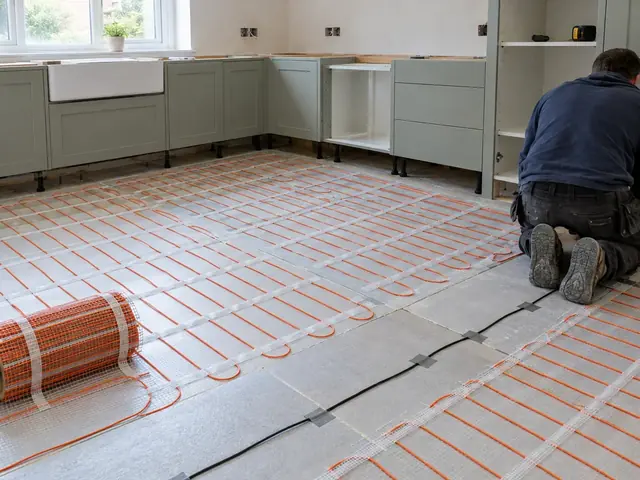
Why do people in Ayrshire choose kitchen underfloor heating?
Kitchen-diners across Ayrshire often have a large stretch of open floor, which can suit a wet system run from the existing boiler or heat pump.
In a compact Ayrshire kitchen with no room for a radiator at all, a plinth heater tucked under a base unit can be the simplest answer.
What does kitchen underfloor heating in Ayrshire include?
Here is what usually goes into kitchen underfloor heating, adjusted to your Ayrshire kitchen after we have measured it:
- A survey of the subfloor, open floor area and existing heating system
- A heating layout drawn to the kitchen plan, clear of units and appliances
- Insulation boards so the floor responds more quickly when the heating comes on
- Electric mats or cables, or wet pipework connected through a manifold
- A new circuit or fused spur, plus a thermostat with a floor sensor
- Screed, overlay boards or levelling compound, left to cure before finishes
- Door thresholds and plinth heights checked against the new floor build-up
- Plinth heaters fitted under base units where wall space for a radiator is short
How much does kitchen underfloor heating cost in Ayrshire?
As a starting point for Ayrshire, these ranges include VAT at 20% and allow for typical labour costs in Scotland. Labour rates in Scotland are generally lower than in London and the South East, so these ranges are a little below the national guide.
| Typical project | Guide price |
|---|---|
| Electric underfloor heating, kitchen floorMat or cable system, insulation board and thermostat | £560–£1,400 |
| Wet underfloor heating, kitchen floorPipes, manifold, screed or overlay boards | £1,400–£3,800 |
| Plinth heater fitted under a base unitElectric or hydronic, where wall space is short | £240–£560 |
Guide prices cover the heating system, insulation boards, controls and connection with testing; the floor finish, subfloor repairs, a consumer unit upgrade and any boiler or heat pump changes are priced separately. Prices include VAT at 20%.
Kitchens in homes across Ayrshire
The housing mix across Ayrshire includes red sandstone villas, sandstone tenement flats, four-in-a-block flats and post-war council-built houses, so no two kitchen fits are quite alike. Four-in-a-block flats and ex-council houses often have a small galley kitchen, while sandstone villas in Ayr tend to have a larger kitchen with a separate dining room.
Ayrshire's mains water is soft, so limescale is rarely a problem and taps, sinks and boiling water taps tend to stay cleaner. Upper four-in-a-block flats usually have their own stair, and coastal towns can have limited parking, so the route for long worktops is checked at the survey.
A four-in-a-block flat usually has a narrow galley, where a well-planned layout with tall storage makes the most of it. Sandstone villa kitchens often sit in former sculleries, and opening into the dining room needs a building warrant if the wall is load-bearing.
Rules for kitchen underfloor heating in Ayrshire
In Scotland, adding underfloor heating to a house kitchen does not normally need a building warrant, but the electrics must meet building standards 4.5 and 4.6 and BS 7671, and you should receive an Electrical Installation Certificate or Minor Works Certificate. A wet system is connected to your existing boiler or heat pump by a heating engineer, and any work on a gas appliance must be carried out by a Gas Safe registered engineer.
Listed sandstone villas and conservation areas in older town centres may need consent for a new external vent, and flat owners may need neighbours' agreement for shared walls.
Before you start
- If the floor is small and there is no wall space for a radiator, a plinth heater under a base unit may be simpler.
- Heat is laid only across the open floor, not under fitted units or appliances, so the heated area is smaller than the room.
- Make sure your chosen finish suits underfloor heating; vinyl tiles and engineered wood have maximum surface temperatures set by their manufacturers.
- Allow time for screed or levelling compound to cure before tiles or other finishes go down, as laying too soon risks cracks and lifting.
- Allow extra days in your Ayrshire kitchen plan for screed or levelling to cure before the tiler arrives, rather than squeezing it into the fit.
- Choose your floor finish first and check its maximum surface temperature, as it decides the thermostat setting and the type of system.
Questions about kitchen underfloor heating in Ayrshire
How much does kitchen underfloor heating cost in Ayrshire?
Kitchen underfloor heating in Ayrshire typically costs £560 to £1,400 including VAT for electric underfloor heating for a kitchen floor, based on prices in Scotland. Larger or more involved jobs cost more, and your price is fixed in writing after a free survey visit.
Do you cover the whole of Ayrshire?
Yes, across mainland Ayrshire. We do not currently cover Arran or Cumbrae. Every job starts with a free survey visit and an itemised written quote.
Will underfloor heating raise my kitchen floor?
Usually, yes. An electric mat with insulation board and tile adhesive adds a modest height, while a wet system in screed adds more. The new level affects door thresholds, the gap under integrated appliances and plinth heights, so it is measured at the survey and the units are set to suit. Low-profile overlay boards can reduce the rise where height is tight.
Is electric or wet underfloor heating better for a kitchen?
It depends on the floor and the heating you already have. Electric mats are thin, quick to lay and suit a single kitchen floor during a refit. Wet systems use warm water from the boiler or heat pump, need more floor depth and a manifold, and make more sense when a larger area, such as a whole kitchen-diner floor, is being relaid at the same time.
Which floor finishes work with underfloor heating?
Porcelain and ceramic tiles work well, because they conduct heat and cope with temperature changes. Luxury vinyl tiles and engineered wood can also be used, but their manufacturers set a maximum surface temperature, so the thermostat needs a floor sensor and a limit set to match. Thick underlays and rugs reduce the heat reaching the room, so check the finish's installation guidance before ordering.
Kitchen underfloor heating in towns across Ayrshire
Choose a town for local guide prices and postcode coverage:
- Kitchen underfloor heating in Kilmarnock
- Kitchen underfloor heating in Ayr
- Kitchen underfloor heating in Irvine
- Kitchen underfloor heating in Kilwinning