
Kitchen flooring · Gloucestershire
Kitchen flooring in Stroud
We take on kitchen flooring in Stroud and the surrounding GL5 postcodes, working to a written scope so you know exactly what is included before anyone starts.
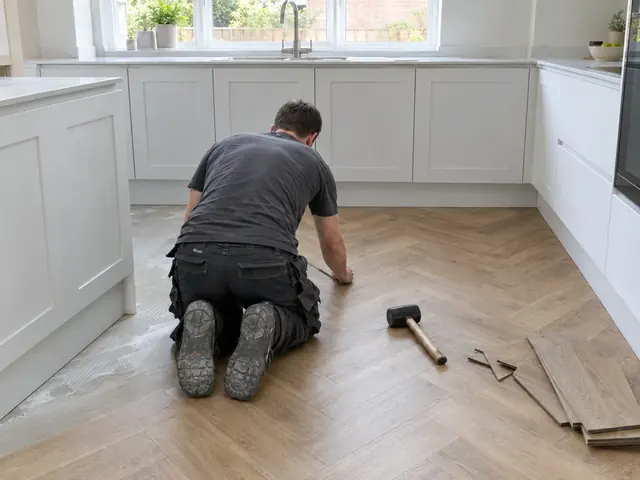
What prompts kitchen flooring in Stroud?
When underfloor heating is going into a Stroud kitchen, the floor finish is planned with it, so the heating, insulation and flooring build-up meet the doorways at the right height.
Families across Gloucestershire often choose LVT for a kitchen because it is warmer and quieter underfoot than tiles and copes well with spills and dropped cups. If your home is in Stroud or close by in Gloucester or Cirencester, the same survey, quote and fitting process applies.
What is in a typical job?
Your written quote lists everything included. For kitchen flooring, that normally means:
- Threshold trims at doorways, with skirting, plinths and kickboards refitted
- Underlay suited to the floor finish, the subfloor and any underfloor heating
- Moisture checks on concrete floors and screeds before any floor finish is laid
- Levelling compound or a plywood overlay to give a flat, firm base
- Flooring run under appliance spaces so machines can be pulled out for servicing
- LVT, sheet vinyl, porcelain or ceramic tiles, or engineered wood laid to suit the room
What should you budget for kitchen flooring in Stroud?
Typical kitchen flooring prices for homes in Stroud, including VAT and adjusted for the South West. Your own figure depends on the size of the kitchen, the layout and what is moving. For the South West, these ranges are close to the national figures.
| Typical project | Guide price |
|---|---|
| LVT or vinyl, kitchen floorPreparation, underlay where needed and trims | £520–£1,500 |
| Porcelain or ceramic tiles, kitchen floorPreparation, adhesive, grout and trims | £930–£2,100 |
| Floor levelling or new plywood baseSo the floor finish and units sit flat | £310–£930 |
Guide prices are for a typical-sized kitchen floor, including preparation, adhesive or underlay and trims; the material you choose, open-plan floor areas and any levelling or plywood base are confirmed at the survey. Prices include VAT at 20%.
What kind of kitchens do we fit in Stroud?
Typical homes in this part of Gloucestershire include cotswold stone cottages, Regency townhouses, Victorian terraces and post-war estate houses. Cotswold stone cottages often have a small kitchen in a rear extension, while Regency townhouses in Cheltenham may have a long kitchen at garden level or in a former basement.
Stone villages with narrow lanes and limited parking can make deliveries slow, and townhouse flats over several floors may mean carrying units up stairs. Hard water is the norm across most of Gloucestershire, so expect limescale on taps and appliances and think about a filter for a boiling water tap.
Building regulations, electrics and gas in Stroud
A new kitchen floor in England needs no planning permission or building regulations approval. In a flat, check the lease first: leases often require a sound-reducing underlay, or forbid hard floors without the freeholder's consent. If electric underfloor heating goes under the new floor on a new circuit, that circuit is notifiable under Part P. In a listed building, removing historic floors may need listed building consent.
Listed stone cottages, Cheltenham's Regency terraces and homes in conservation areas may need consent before new vents are cut or historic features are removed.
Tips before you start
- Keep a few spare boards or tiles from your Stroud kitchen floor in the loft or garage, so a damaged piece can be swapped for an exact match later.
- Measure the gap under internal doors in your Stroud home before choosing flooring; thicker tiles or an overlay may mean doors need trimming.
- If your Gloucestershire home has a newly screeded floor, for example in an extension your builder has finished, ask for a moisture test before the flooring is booked.
- Decide early whether the floor runs under the units or stops at the plinths; it affects ordering quantities, plinth heights and how the kitchen is fitted.
Questions about kitchen flooring in Stroud
How much does kitchen flooring cost in Stroud?
For an LVT or vinyl kitchen floor, budget around £520 to £1,500 including VAT in Stroud. That reflects typical costs in the South West; we confirm the actual figure in writing once we have measured up.
Do you cover all of Stroud?
Yes. We work across Stroud, including the GL5 postcode district, and nearby towns such as Gloucester and Cirencester. Book a free survey visit and we will arrange a time that suits you.
How long does it take to lay a kitchen floor?
Most kitchen floors take one to two days to lay once the base is ready. Add curing time if a levelling compound is used, which depends on the product and its thickness, and allow much longer for a new screed, which must be dry enough before most floors go down. Tiled floors also need the adhesive and grout to set before heavy use.
Does my kitchen floor need levelling before new flooring?
Often, yes. Thin floors such as LVT and sheet vinyl show every dip and ridge underneath, and tiles can crack if the base flexes or is uneven. Concrete floors are usually smoothed with a levelling compound, while timber floorboards are normally overlaid with plywood screwed down at close centres. We check the floor at the survey and price any preparation as its own line.
Is engineered wood a good choice for a kitchen floor?
It can be, but it needs more care than LVT or tiles. Engineered wood can swell or stain if water sits on it, so it is less suited to the areas around a sink or dishwasher, where leaks are most likely. If you choose it, pick a board the maker approves for kitchens, wipe spills promptly and keep the finish maintained.
Also covering nearby towns
Neighbouring towns where we offer kitchen flooring:
- Kitchen flooring in Gloucester
- Kitchen flooring in Cirencester
- Kitchen flooring in Cheltenham
- Kitchen flooring in Malmesbury
- Kitchen flooring in Lydney
- Kitchen flooring in Tewkesbury
- Kitchen flooring across Gloucestershire