
Kitchen flooring · Greater London
Kitchen flooring in Pinner
We take on kitchen flooring in Pinner and the surrounding HA5 postcodes, working to a written scope so you know exactly what is included before anyone starts.
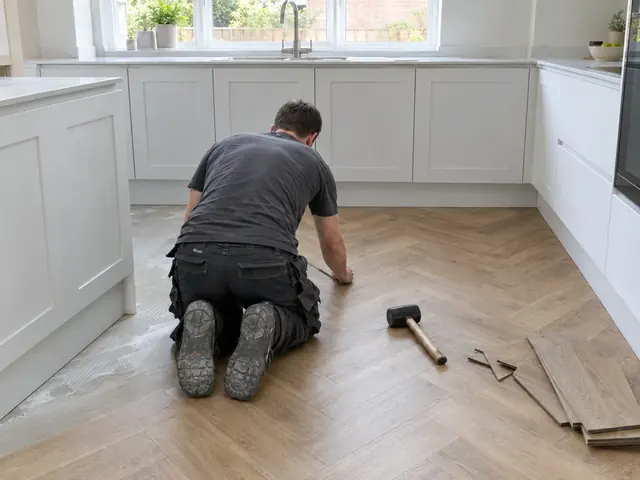
What prompts kitchen flooring in Pinner?
Families across Greater London often choose LVT for a kitchen because it is warmer and quieter underfoot than tiles and copes well with spills and dropped cups.
If your Pinner kitchen has curling vinyl, cracked tiles or boards that have swollen near the sink, a new floor can be laid without changing the units. Our Greater London coverage reaches every part of Pinner (HA5) and out towards Wealdstone.
What does the job involve?
Your written quote lists everything included. For kitchen flooring, that normally means:
- Underlay suited to the floor finish, the subfloor and any underfloor heating
- Old coverings lifted and removed, with pre-2000 floor tiles checked for asbestos first
- Free survey visit to check the subfloor, measure up and give an itemised quote
- Moisture checks on concrete floors and screeds before any floor finish is laid
- LVT, sheet vinyl, porcelain or ceramic tiles, or engineered wood laid to suit the room
- Levelling compound or a plywood overlay to give a flat, firm base
How much does kitchen flooring cost in Pinner?
As a starting point for Pinner, these ranges include VAT at 20% and allow for typical labour costs in London. Expect costs in London to sit somewhat above UK averages, reflecting local labour rates.
| Typical project | Guide price |
|---|---|
| LVT or vinyl, kitchen floorPreparation, underlay where needed and trims | £650–£2,000 |
| Porcelain or ceramic tiles, kitchen floorPreparation, adhesive, grout and trims | £1,200–£2,600 |
| Floor levelling or new plywood baseSo the floor finish and units sit flat | £390–£1,200 |
Guide prices are for a typical-sized kitchen floor, including preparation, adhesive or underlay and trims; the material you choose, open-plan floor areas and any levelling or plywood base are confirmed at the survey. Prices include VAT at 20%.
Local homes and their kitchens
Across Greater London you will often find Victorian and Edwardian terraces, conversion flats, mansion block flats and 1930s semis, and each shapes the kitchen differently. Victorian terraces often have a narrow galley beside the side return, while conversion flats and mansion blocks usually fit the kitchen into a small room or along one living-room wall.
Permit parking, red routes and flats without lifts are common, so parking suspensions, stair carries and lift bookings may need arranging before delivery day. London's mains water is hard, so limescale builds quickly on taps and boiling water taps, and a scale-reducing filter is worth planning in.
What rules apply to kitchen flooring in Pinner?
A new kitchen floor in England needs no planning permission or building regulations approval. In a flat, check the lease first: leases often require a sound-reducing underlay, or forbid hard floors without the freeholder's consent. If electric underfloor heating goes under the new floor on a new circuit, that circuit is notifiable under Part P. In a listed building, removing historic floors may need listed building consent.
Conservation areas are widespread across London, so a new extractor vent on a front wall may need permission, and leaseholders usually need the freeholder's written consent first.
Before you book kitchen flooring in Pinner
- Measure the gap under internal doors in your Pinner home before choosing flooring; thicker tiles or an overlay may mean doors need trimming.
- Choose trims for each doorway at the survey, so the colour and height suit the floor in the next room of your Pinner home as well as the kitchen.
- If your Pinner house was built before 2000 and still has old vinyl or thermoplastic tiles, have them tested for asbestos before anyone lifts or sands them.
- Floating floors such as click LVT or engineered boards should not be trapped under heavy fixed units or an island; follow the flooring maker's instructions.
Questions about kitchen flooring in Pinner
How much does kitchen flooring cost in Pinner?
For an LVT or vinyl kitchen floor, budget around £650 to £2,000 including VAT in Pinner. That reflects typical costs in London; we confirm the actual figure in writing once we have measured up.
Do you cover all of Pinner?
Yes. We work across Pinner, including the HA5 postcode district, and nearby towns such as Wealdstone and Ruislip. Book a free survey visit and we will arrange a time that suits you.
Can I have a hard floor in my flat's kitchen?
Usually, but check your lease first. Leases often require a sound-reducing underlay under hard floors, or say that tiles, wood or LVT can only be laid with the freeholder's written consent, to protect neighbours below from impact noise. In Scotland, check your title deeds and any deed of conditions. If the wording is unclear, ask your managing agent before you order flooring.
How long does it take to lay a kitchen floor?
Most kitchen floors take one to two days to lay once the base is ready. Add curing time if a levelling compound is used, which depends on the product and its thickness, and allow much longer for a new screed, which must be dry enough before most floors go down. Tiled floors also need the adhesive and grout to set before heavy use.
Does my kitchen floor need levelling before new flooring?
Often, yes. Thin floors such as LVT and sheet vinyl show every dip and ridge underneath, and tiles can crack if the base flexes or is uneven. Concrete floors are usually smoothed with a levelling compound, while timber floorboards are normally overlaid with plywood screwed down at close centres. We check the floor at the survey and price any preparation as its own line.
Kitchen flooring in neighbouring towns
The same service is available a short drive from Pinner, including:
- Kitchen flooring in Wealdstone
- Kitchen flooring in Ruislip
- Kitchen flooring in Harrow
- Kitchen flooring in South Ruislip
- Kitchen flooring in Northolt
- Kitchen flooring in Bushey
- Kitchen flooring across Greater London