
Kitchen lighting · Cambridgeshire
Kitchen lighting in March
We take on kitchen lighting in March and the surrounding PE15 postcodes, working to a written scope so you know exactly what is included before anyone starts.
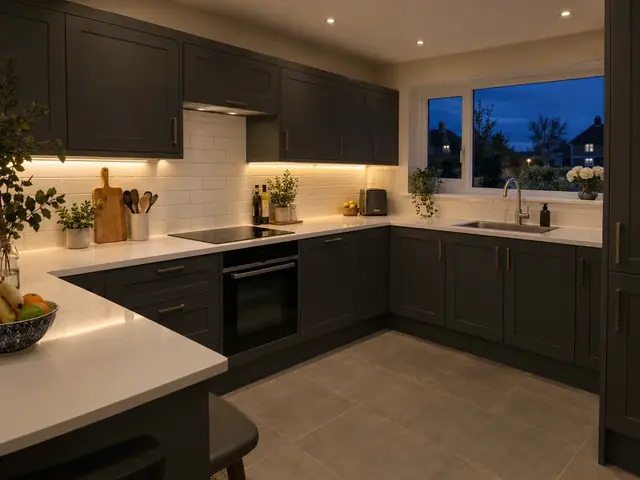
When does kitchen lighting make sense in March?
When a wall comes out in Cambridgeshire to make a kitchen-diner, one ceiling light no longer works, and the space needs separate light for cooking and for eating.
If your March kitchen is a narrow galley, under-cabinet strips and a line of downlights along the walkway make both worktops usable on dark afternoons. If your home is in March or close by in Wisbech or Ely, the same survey, quote and fitting process applies.
What does the job involve?
Here is what usually goes into kitchen lighting, adjusted to your March kitchen after we have measured it:
- Recessed downlights, fire-rated where the ceiling needs to stay a fire separation
- Switching by zone, with dimmers matched to the lamps and drivers
- Plinth, cornice or glass-cabinet LED strips with hidden drivers
- Under-cabinet strip or puck lights to light the worktop evenly
- Drivers placed where they can be reached for replacement later
- Testing and certification to BS 7671, with notification where required
What does kitchen lighting cost in March?
As a starting point for March, these ranges include VAT at 20% and allow for typical labour costs in the East of England. Expect costs in the East of England to sit somewhat above UK averages, reflecting local labour rates.
| Typical project | Guide price |
|---|---|
| Recessed ceiling downlights (per light)Fire-rated where required, wired and tested | £40–£90 each |
| Under-cabinet LED lightingStrip or puck lights with a driver and switch | £220–£490 |
| Pendant lights over an island or tableNew ceiling point and fitting | £110–£270 each |
| Plinth or cornice LED stripsLow-voltage strip with a driver | £160–£430 |
Guide prices cover labour, cable, drivers, switches and testing with standard downlights and LED strips; decorative pendants you choose, smart lighting controls and ceiling repairs are priced separately. Prices include VAT at 20%.
Local homes and their kitchens
In and around March, homes range across Victorian terraces, 1930s semis, post-war estate houses and fenland bungalows and farmhouses. Terraced houses in Cambridge and Peterborough often have a narrow galley at the back, while Fen bungalows tend to have a simple square kitchen beside the living room.
Water across Cambridgeshire is very hard, so limescale on taps and boiling water taps is common and a filter or softener is worth thinking about. Fen roads and farm tracks can be narrow for delivery lorries, and city-centre terraces often have permit parking and no rear access for long worktops.
Do you need approval for kitchen lighting in March?
In England, adding lights to an existing lighting circuit in a kitchen is not notifiable, but a new lighting circuit is, so it is either self-certified by an electrician registered with a competent person scheme or approved through building control. Either way the work must meet BS 7671 and be certified. Recessed downlights may need to be fire-rated where the ceiling forms a fire separation, for example below another flat.
Listed houses in historic centres such as Cambridge and Ely may need consent for internal changes or a new vent, although a straightforward kitchen fit needs no planning permission.
Practical advice for March homeowners
- Note the driver type for each LED strip and keep it with your kitchen paperwork, so a failed driver can be matched quickly.
- For a March kitchen-diner, put the dining pendants on their own switch so the table can be lit while the kitchen side is off.
- Measure your island before choosing pendants for your March home; two or three evenly spaced lights often look more balanced than one large fitting.
- Position under-cabinet lights towards the front of the wall units, so light falls on the worktop rather than glaring off a glossy splashback.
Questions about kitchen lighting in March
How much does kitchen lighting cost in March?
For a recessed ceiling downlight, budget around £40 to £90 each including VAT in March. That reflects typical costs in the East of England; we confirm the actual figure in writing once we have measured up.
Which parts of March do you work in?
All of them. Our Cambridgeshire coverage takes in the whole of March, including the PE15 postcode district, as well as surrounding towns such as Wisbech. If you are unsure, send us your postcode.
Do kitchen downlights need to be fire-rated?
Sometimes, and it is often the sensible choice. Where the ceiling forms a fire separation, such as between flats, or where its plasterboard is relied on for fire resistance, cutting holes can weaken it, so fire-rated downlights or covers may be needed. The electrician checks the ceiling build-up before choosing fittings, and our downlight prices allow for fire-rated units where they are required.
How many downlights does a kitchen need?
There is no fixed number; it depends on the room size, ceiling height, beam angle and brightness of each light. Rather than spacing them in an even grid, it works better to set them out so light falls on the worktops and walkways and not on top of the wall units. We mark positions on the plan against the ceiling joists before any holes are cut.
Can under-cabinet lights be added to an existing kitchen?
Yes, usually. The cable can often run behind the wall units or through a short chase, with the driver hidden on top of a unit or in a nearby cupboard. It is neater when the wall units are off or the walls are being retiled, but a careful retrofit is common. In Wales this extends a circuit in a kitchen, so it is notifiable.
Nearby places we cover
Close to March? We cover these nearby towns too:
- Kitchen lighting in Wisbech
- Kitchen lighting in Ely
- Kitchen lighting in Peterborough
- Kitchen lighting in King's Lynn
- Kitchen lighting in Spalding
- Kitchen lighting in Huntingdon
- Kitchen lighting across Cambridgeshire