
Kitchen island installation · England
Kitchen island installation in Bristol
Our kitchen island installation work covers the whole of Bristol, and we also work in neighbouring Somerset and Gloucestershire.
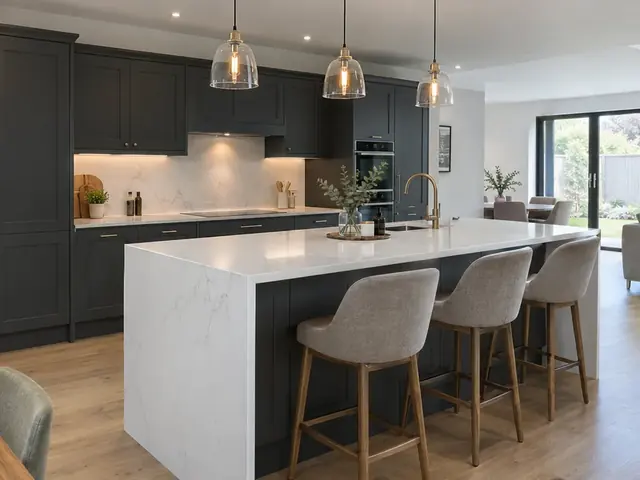
Why do people in Bristol choose kitchen island installation?
If your Bristol kitchen has a table that nobody really sits at, an island can replace it with storage, worktop and a couple of stools in a similar footprint.
Homeowners in Bristol often ask for an island once a kitchen and dining room have been opened up, so the larger room has a working centre instead of an empty middle.
What does kitchen island installation in Bristol include?
Your written quote lists everything included. For kitchen island installation, that normally means:
- Free survey visit to measure clearances and check how the floor is built
- Island carcasses fixed to the floor and levelled to match the main runs
- Sockets and a cable run to the island, tested and certified to BS 7671
- Hot and cold supplies and a waste with a steady fall for an island sink
- Chasing or ducting through a concrete floor, then reinstating the surface
- Island hood, ceiling extractor or downdraft unit with its ducting route planned first
- Seating overhang supported with hidden brackets, a leg or an end panel
- End panels, back panels and plinths finished on every visible face
How much does kitchen island installation cost in Bristol?
As a starting point for Bristol, these ranges include VAT at 20% and allow for typical labour costs in the South West. For the South West, these ranges are close to the national figures.
| Typical project | Guide price |
|---|---|
| Island fitted, no services, mid-rangeUnits, worktop and end panels, supplied and fitted | £2,100–£5,200 |
| Power to an island on a suspended floorSockets and the cable run to the island | £260–£620 |
| Hot, cold and waste to an island sinkPipework run under the floor | £310–£820 |
| Extra for chasing services into a concrete floorCutting, ducting and reinstating the floor | £410–£1,500 |
| Large bespoke islandCabinets on both faces, stone worktop, appliances | £6,200–£12,400 |
Guide ranges cover the island units, worktop and fitting, with power, plumbing and floor chasing shown as separate lines; island hoods, pendant lights and new floor finishes are quoted on top. Prices include VAT at 20%.
Kitchens in homes across Bristol
The housing mix across Bristol includes Victorian terraces, Georgian townhouses and flats, 1930s semis and flats in converted houses, so no two kitchen fits are quite alike. Bristol's Victorian terraces often have a narrow rear galley, while Georgian houses split into flats can have kitchens tucked into former bedrooms or reception rooms.
Bristol's mains water is hard, so limescale on taps, kettles and boiling water taps is common, and an inline filter or softener can help. Steep hillside streets, permit parking and terraces with no rear access are common in the city, so long worktops may need careful handling through the front door.
Many Bristol terraces have a small kitchen behind the back room, and opening the two into one space is a popular change. Where a flat sits in a converted Georgian or Victorian house, the work often means fitting a lot into a modest room while working around shared walls and services.
Rules for kitchen island installation in Bristol
Adding an island does not need planning permission in England, though a listed building may need listed building consent. Taking power to it from an existing kitchen circuit is not notifiable, but it must meet BS 7671; a new circuit for an island induction hob is notifiable under Part P, so it is certified through a competent person scheme or building control. A ducted island hood should meet Approved Document F, and only a Gas Safe registered engineer may run gas to an island hob.
Many of the city's older streets are conservation areas and some houses are listed, so a new extractor vent or the removal of historic features may need consent first.
Before you start
- Decide whether the island needs power, water or a hob before the floor is laid, because adding services later means lifting it.
- Choose whether the floor finish runs under the island or stops at the plinth, as it affects future changes and underfloor heating.
- An island hob needs extraction: a hood or ceiling extractor with a ducting route to outside, or a downdraft unit inside the island.
- Common guidance is around a metre of clear walkway round an island, and more where two people cook or a dishwasher door opens.
- Decide what the island will store before ordering units: deep pan drawers near the hob, a bin pull-out by the sink and shallow cupboards on the seating side.
- Find out whether your Bristol home has a suspended timber or solid concrete ground floor; air bricks low on the outside walls often point to timber.
Questions about kitchen island installation in Bristol
How much does kitchen island installation cost in Bristol?
Guide prices in Bristol are about £2,100 to £5,200 including VAT for a mid-range island with no services, supplied and fitted. The final price depends on the size of the kitchen and what is moving, and is set out in an itemised written quote.
Do you cover the whole of Bristol?
Yes. We carry out kitchen island installation across Bristol. Every job starts with a free survey visit and an itemised written quote.
How much space do I need around a kitchen island?
Common guidance is around a metre of clear walkway on each side of an island, and more on the working side if two people cook at once or the dishwasher and oven doors open into the gap. In a narrower room, a peninsula joined to one run often works better. We measure at the survey and can mark the island out on the floor so you can walk round it before anything is ordered.
Can an island have a sink or hob on a concrete floor?
Yes, but it takes more work. On a solid floor, cables and pipes are chased into the concrete or run in ducting, then the floor is made good before the finish goes down. The sink waste needs a steady fall to the drain, which can limit how far from an outside wall the sink can sit. We check the floor and the drain route at the survey before pricing.
What extraction works over an island hob?
There are three main options. An island hood hangs above the hob from the ceiling; a ceiling extractor sits almost flush with the plaster; and a downdraft extractor rises from the worktop behind the hob and is ducted through the plinth or under the floor. Ducted versions need a route to an outside wall. Recirculating versions filter grease and smells but do not remove moisture, so the room needs another extract.